Mac to ATX Signal (Power) Inverter
(from Just
in Case
– The
Genuine Mac ATX Power Supply)
Home Site Map Recent Activity PM 8500 Project Beige G3 Project My Apples
Some
terms
PS
= power
supply, ATX = PC
power supply, V or v = volts, lead = wire from PS to motherboard
This
basic circuit was
taken from the XLR8
Your Mac
web
site, the first, and often, the only place a Mac hobbyist needs to go
to get
technical details, advice, and benchmarks, along with all the tricks to
do this
stuff.
The circuit discussed here
is as diagramed on that site in an article discussing
PM 7500 to ATX case
conversions.
Several
other related articles also
discuss it or alternative ideas. I
have made only minor component changes as necessary since both the
original
author and I used whatever transistors were lying about.
Introduction:
Since older Macs use a different method than PCs and newer Macs to activate their power supplies one must create some sort of interface hardware to allow soft power functionality (the ability of the motherboard to control the PS to turn the computer on or off as opposed to hitting a physical power switch).
Both Macs (old and new) and PCs normally get a constant 5V feed from the PS to allow some basic functions, such as auto restart with power failures, timed startup, and soft power startup, among others. Older Mac motherboards activate their power supplies by sending a 5V signal to the PS on a certain lead (goes high in EE talk). PCs and newer Macs turn on the power supply by grounding a certain lead from the power supply (goes low) which is otherwise held at 5v by the PS.
Technical
Discussion and Theory:
This
discussion is not
exhaustive (maybe exhausting) and is merely to provide some conceptual
framework for understanding this circuit.
Glossing over and hand
waiving is in full effect.
The problem with soft power is this. Both Macs and PCs use a power-on lead connected between the motherboard and the PS to control the PS. The Mac turns on the PS by sending a 5V signal over this lead, whereas the PC activates its power supply by grounding the lead. Therefore to use a new ATX style power supply in an older Mac one must take the 5v signal from the Mac and use it the ground the power-on lead off the PC power supply. One can imagine simple ways to do this including just connecting 5V relay to the Mac power-on lead that grounds the PC power-on lead when activated however since these are computers, and Macs, we have to be somewhat elegant (this would probable not work in practice as the relay would require more current than the motherboard can provide).
Other ways include the use of simple IC amplifier or logic chips, but one easy and interesting way is to use spare basic electronic parts to build a simple digital circuit. In the binary world of digital circuits where a 1 is 5V and a 0 is 0V (typically) we need a circuit that inverts a 1 (5v) to a 0 (0v). What do we use to do this? Why the base unit of all digital devices, the transistor.
Basically a transistor is a solid-state device that is the electric equivalent of a knob or lever controlling a flow valve. It basically consists of three leads, one of which uses an input signal to control a current flowing across the other two leads, often much larger then the input signal. This makes them well suited for amplifiers in that a smaller input signal can be used to control the “valve” often of a much larger current. Like any “real” valve it takes a certain minimal signal to open the valve at all, and above a certain point the valve is completely open and more input doesn’t give more output. In this way they are like a switch or relay and are ideal for digital (on/off) circuits. There lots of different transistors many of which can be used for either purpose but most are designed for a specific use. Analog signal amplifiers operate with input signals within the variable range when changing the input amplitude changes the output amplitude by a proportional amount. When the input goes above the operating range and the valve is fully open (or at least very non-linear ) you get distortion (the waveform is “cut off” or flattened). “Power Amplifier” transistors are designed for uses where a small input current controls a large output current and are often larger, thicker, and can be attached to heat sinks. “Signal” transistors are designed to have rapidly responsive time (quick moving valves) for amplifying high frequency signals. Some of course are designed to operate as digital switches. The variety and combinations are endless.
For this simple circuit we are going to make some likely assumptions about the system, plus a requirement, and then use Kirchhoff’s voltage law (one of the two base principals of electrical circuits) to effect our signal inversion.
- The
first assumption
is that the 5v signal from the ATX PS is designed to be easy to ground. In
other words is doesn’t have much current to provide so as
soon as the resistance drops it runs out of current to maintain
electrical pressure and the voltage drops.
Therefore our
circuit doesn’t have to support high flow from the PS when it
grounds the lead.
- This
second assumption is that the motherboard also doesn’t
have much current to provide to its 5V lead to turn the PS on so our
circuit can’t require
much current to function.
- The
circuit must also function continuously while the PS is on
since the
motherboard signal maintains the on state of the PS such that the PS
turns off
with signal loss (high or low as required). In other words the
motherboard
keeps its finger on the power button if it wants power.
To build the diagramed circuit we need a type of transistor called NPN (there two fundamental types, NPN and PNP which have to do with how the current flows – sort of like, do you push or pull the lever that controls the valve?). We are going to make a circuit that uses the 5v constant from the PS to push the PS power-on lead to 0 V when the activated transistor provides a low resistance path for that lead to ground. To do this we are going to depend on Kirchhoff’s voltage law that states (paraphrased for our purposes): the sum of all voltages along a given path around a circuit add to zero if you start and stop at the same point. This sounds complicated but is equivalent to saying that if you fell from building twenty feet off the ground and ended up on the ground you changed your position by 20 and no other amount. This is true regardless of whether you fell straight to the ground, or a UFO intercepted you half way down and took you to Jupiter for pizza and a bikini wax before setting you on the ground.
In our circuit we are going to place the transistor such that when the valve is closed the 5V constant and PS power-on leads are separated by a small resistance compared to the almost infinite resistance of the open value and are therefore essentially the same voltage. When the 5v input from the motherboard activates the transistor (opens the valve) the previously small resistance separating the two leads (PS 5v constant and PS power-on) is now very large compared to the small resistance of the open valve and since the voltage from the 5v constant to ground must add up to 5v, and the PS power-on lead is below the 5v constant and has only the very low resistance separating it from ground, the power-on lead gets essentially forced to zero, or near enough to turn on the PS we hope. Since the voltage divides up based on resistance the small resistance gets a smaller percentage of the 5v total than the larger resistance.
Sounds complicated, probably because I suck as a teacher, but here is the basic circuit as describe on the XLR8 Your Mac site.
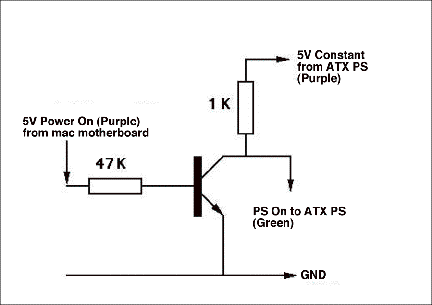
Power
Inverter circuit for PM 7500 motherboard using
BSX-20 NPN transistor
This circuit is based on one described on the XLR8 Your Mac site by the original author using a working machine to determine the resistances values that activate the PS without pulling too much current from the motherboard. These values vary as to particular components selected. When too much current is drawn the current fails, the valve closes, and the PS turns off giving the effect of the computer turning on for just a second or so then going back off.
A quick and shoddy circuit analysis shows a relatively large resistor on the Mac power-on lead to limit the current output but still allow activation of the transistor and with the PS power-on lead clearly positioned to be connected to ground when the transistor is turned on.
So, you ask cleverly, if the transistor switching on grounds the PS power-on lead, we win!, why do we need that other complicated Kirch… whoever’s thing to help it? I hate that part of it and it makes me violent. The answer…just electrical reality. The transistor being on doesn’t create a short circuit, just a really low resistance one. Since the PS doesn’t provide much current for that lead when the current requirement does increase very much as the resistance drops, the current is unavailable so the voltage has to drop, but not necessarily to zero. Maybe just to 3 v, or 2.1 v, or even 0.7 volts, maybe not enough to activate the PS. If it is enough at first the available current may drift under PS load such that the PS is unstable in use
Another simple way to think about this: think water, pressure and flow. Water is electricity, pressure and voltage is the force pushing the water or electricity along, and flow is current, or how much water or electricity is flowing. This is not just a vague analogy, is it essentially exactly what is happening and really, electrical circuits can be thought of as nothing more than pumps, pipes of various sizes and lengths, valves, diaphragms, reservoirs, ect… Using this model think of the PS power-on lead being a little toothpick sized pipe with 5 PSI of water pressure originating from small limited water supply. This tinny pipe is connected via a value to a large pipe than opens onto the ground. When that value is closed the pressure in that little pipe before the value is 5 PSI, but when you open that value the pressure in that pipe drops because lots of water is flowing out but there is just not much water available to flow in and replace it. How much the pressure drops depends on just how much flow is available, and how big the pipe really is. It’s a little more hand-wavy to add the higher pressure forcing down the low one, but if you think about it, that will come to you as well.
To illustrate our circuit in action two electrically simplified diagrams are provided, one with the PS off, and one on (The complete effect of the transistor in the circuit is not addressed).
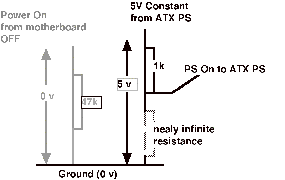
Inverter Circuit Power Supply Off with Power-On lead from Mac motherboard off and therefore the PS off.
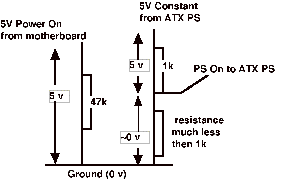
Inverter
Circuit Power Supply On with
Mac 5 v input opening the circuit between the PS power-on lead
and ground and using the 5 v constant to push that lead closer to 0 v
to
activate the PS.
My Power Inverter (actually building it):
Ok, enough with the longhaired stuff. Here is what I did, and what I found.
First before even starting this (and as discussed elsewhere) I confirmed that with the Power Supply I was going to use properly loaded I could activate the power supply by grounding the PS power-on lead.
The
important leads to identify to build this circuit were these.
Mac side
|
|
|
|
|
|
Yellow |
+5v
Constant |
|
Purple |
Power
on
“hi” lead |
|
Black |
Gnd |
|
|
|
ATX PS
|
|
|
|
|
|
Purple |
+5v
constant |
|
Green |
Power
On lead |
|
Black |
Gnd |
Color Matching Mac motherboard to ATX PS
I pulled out my old components box from when I was an Electrical Engineering major in the late 80’s and dug through stuff I haven’t seen since, well, the late 80’s. I had a bunch of odd transistors, resistors, diodes, op amps, ect… Without much more research, remembering and analysis than I was willing to do I couldn’t tell which transistor might be activate the PS at a current the motherboard could support so I just grabbed a few. Also not quite remembering how to read resistors (‘B_ Boys R_ Our Young Girls But Violet Gives Willingly’ came to mind, and then I had to wash out my mind with soap and water) I just used the multi-tester to find resistors that added up in series to 47 K and 1 K. I chose an old TIP 32 A NPN power transistor to give a try. I wired it up and to my surprise when I hit the button telling the motherboard to fire up the PS, it fired up… and promptly went off as soon as I let go. This told me the motherboard was overloaded and couldn’t provide the current required to keep the transistor on. The resistances need changing. Cringing at 500 resistor changes I dug some more and came up with exactly what I needed, a 1K potentiometer and a 50 K potentiometer (adjustable resistors than can be set between 0 ohms and the max rating of the “pot”). This time I cut out some circuit board, laid out the wires, and soldered it all together. I then hooked it up to the PS and motherboard and set my multi-tester to monitor the voltage across the PS power-on lead so at least I new if I was heading in the right direction. The pot idea was good because the window of function was really small and it took some work to hit it. Once I did it has remained stable since requiring adjusting only once after a big move and my big hand hitting it (but I marked the spots on the pots and the voltages across all leads, and cut off my hand). My tunable modification is diagramed below.
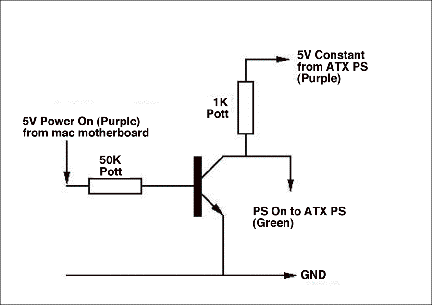
Power
Inverter
used in PM 8500 using TIP 32 A NPN transistor.
Findings and Function:
It was pretty easy to turn the transistor on and drive the voltage of the PS power-on lead to near zero, but the motherboard was clearly overloaded. For my components, without the higher voltage forcing the Power On lead to zero activation of the transistor causes the voltage across the PS power-on lead to drop to around 2.5v. Considering this was a pretty heavy-duty power transistor it probably had a pretty big resistance even when on. As I slowly adjusted both pots I found the PS would activate around a voltage of 0.7, but the motherboard would overload around 0.5 so the flow from the PS side of the circuit was clearly affecting the resistance the motherboard was seeing in a big way (and thus why both pots had to be adjusted together). I finally hit a happy medium and had honest to goodness soft power capability.
Realizing that my signal inverter required 4 leads to function (Mac power-on, PS power-on, 5v constant, and ground) and wanting it easy to move, disconnect, and work with I hooked up standard internal drive male and female connectors (clearly labeled with the male end on the power inverter and the female end wired into the PS wiring harness). Also, since a really locked up Mac doesn’t respond to the soft power button, and I hate having to unplug the power cable, I connected the reset button on the case (with the momentary switch swapped of for a same sized single throw one) to open-circuit the green (PS power-on) lead when depressed allowing me to always be able to pull the plug without the risk of additional exercise.
All in all it was an easy fun and free circuit to build, it was nice to recall some of my EE training, and it was cool.
Artist (NOT) rendering of my hand made component,
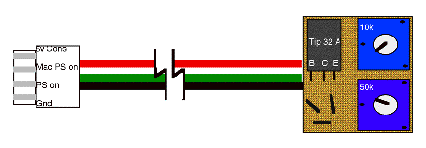
Signal
(Power) Inverter for
Mac to ATX case conversion soft power.
Counter Display Suspended by Page

Created ~8/2004
Modified 11/04/04
Modified 06/17/04
Modified 12/26/2006 - Updated to Nvu to correct various tags and errors created by MS Words HTML creation